Showing posts with label NFL. Show all posts

Wednesday, August 21, 2013

15 Tycoons Who Won't Leave Their Fortunes to Their Kids

Not all of the world's billionaires are dedicated to being extraordinarily altruistic — many decide to spend their money indulging in fancy cars, planes, and yachts.

But others want to spread as much of their wealth as possible before they die. A select few even want that last check to only cover the cost of their funeral.

Of course, not everyone stands to gain from such selflessness — namely, the children of these generous donors.

Though they will still have untold opportunities, advantages, and connections, to help them succeed, the children of these 15 tycoons won't be living large off their inheritances.

—Eric Goldschein also contributed to this story.


1. Business magnate Warren Buffett
REUTERS/Rick Wilking

As an incredibly wealthy investor and philanthropist, Buffett has pledged to give away99% of his wealth, either during his life or when he dies. He started by promising 83% of it to the Gates Foundation, according to FORTUNE Magazine.

The Oracle of Omaha isn't worried about his children not getting their fair share. Echoing a common sentiment on this list, Buffett said in his letter to the Gates Foundation: "I want to give my kids just enough so that they would feel that they could do anything, but not so much that they would feel like doing nothing."

2. EBay founder Pierre Omidyar

Brian Harkin/Getty Images

Ever since Omidyar became a billionaire when he was 31 years old, the eBay founder has made it his life's work to donate the majority of his money to those less fortunate instead of to his three children, according to Forbes.

He signed the Gates and Buffett Giving Pledge in 2010, and continuously gives eBay shares to the Omidyar Network, his philanthropic investment firm.

He and his wife Pam are also the single biggest private donors to the fight against the human trafficking industry.

3. New York City Mayor Michael Bloomberg

Andrew Burton/Getty Images

Bloomberg gets paid $1 a year for his government duties because with a net worth of $19.5 billion, he's pretty much set financially.  

But Bloomberg is also an avid philanthropist, having donated millions to Johns Hopkins University, the Carnegie Corporation, and thousands of other non-profits.

In his letter to The Giving Pledge, Bloomberg wrote that "nearly all of my net worth will be given away in the years ahead or left to my foundation."

Bloomberg's two daughters, however, may be left to foot the bill upon his death.Bloomberg once said, "the best financial planning ends with bouncing the check to the undertaker."

4. Rockstar Gene Simmons

Frazer Harrison/Getty Images

The bassist for KISS, one of the best-selling American bands of all time, is a self-made man. He was born in Israel, moved to Queens with his mother, and started a group that would end up compiling 28 gold records over the years. 

Simmons wants the same path for his two kids, Nick and Sophie. He told CNBC several years ago: "...in terms of an inheritance and stuff, they're gonna be taken care of, but they will never be rich off my money. Because every year they should be forced to get up out of bed, and go out and work and make their own way."

So the $300 million bucks that belong to Simmons will be headed somewhere else upon his death. 

5. Australian iron magnate Gina Rinehart

Paul Kane/Getty Images

Rinehart — the richest woman in Australia — wants to cut her children out of their inheritance.

She herself inherited her company and fortune from her father, Lang Hancock, and her children were also named in his estate.

But court documents in the Australian media show that Rinehart doesn't believe her four kids are fit to manage the family fortune.

“None of the plaintiffs has the requisite capacity or skill, nor the knowledge, experience, judgment or responsible work ethic to administer a trust in the nature of the trust in particular as part of the growing HPPL Group,” she once claimed in court papers.

6. Microsoft founder and CEO Bill Gates

Stefan Postles/Getty Images

Bill Gates is one of the richest people in the world. But he and his wife Melinda aren't interested in keeping their money for themselves, or for their three children.

"I knew I didn't think it was a good idea to give the money to my kids. That wouldn't be good either for my kids or society," he told The Sun in 2010.

Instead, the Bill & Melinda Gates Foundation was founded in 1994, and today has assets of over $37 billion. The Foundation even started "The Giving Pledge," which invites other wealthy individuals to join the Gates' lead and donate half their money to charity. 

7. Actor Jackie Chan

REUTERS/Jonathan Alcorn

The movie star announced in 2011 that he had decided to give away half his money to charity when he dies. Chan added that he was not planning on leaving his son Jaycee any of the millions of dollars he has made during his film career.

"If he is capable, he can make his own money. If he is not, then he will just be wasting my money," Channel NewsAsia quoted Chan as saying.

8. Home Depot co-founder Bernard Marcus

Bernard Marcus, left (AP Photo/Alan Mothner)

Marcus grew up in Newark, New Jersey to Russian immigrant parents, and went on to start Home Depot. His retail success helped him accumulate $1.5 billion in net worth. His philanthropic efforts include funding the Georgia Aquarium and starting the Marcus Foundation. 

Not wanting his kids to inherit large sums of money — for their own good, he told Forbes — Marcus plans on giving the majority of his Home Depot stock to his foundation, which benefits the handicapped and education.

9. Businessman Chuck Feeney

The Atlantic Wire

Chuck Feeney is the the co-founder of Duty-Free Shoppers Group (those airport shops), and was one of the world's billionaires in the late 1980s until he transferred all his wealth to his foundation, Atlantic Philanthropies, according to Forbes.

Before giving away their inheritance, he also went to great lengths to teach his children the value of saving money, including making his kids chat with their friends on payphones, work during their vacations, and work through college, according to The Daily Mail.

Today, it's rumored Feeney doesn't even own a house or a car. He once famously told The New York Times, "I want the last check I write to bounce."

10. British Chef Nigella Lawson

AP Photo/Lionel Cironneau

Lawson is a best-selling author and TV personality, which made her a millionaire even before she married (and then later divorced) wealthy advertising tycoon and art collector Charles Saatchi.

Though Lawson herself comes from a wealthy background, she seems to be a firm believer in not giving her two children that same advantage. She came under fire for saying, "I am determined that my children should have no financial security. It ruins people not having to earn money."

She followed up that statement by saying she didn't plan on leaving her kids "destitute," but stood by the idea that they would have to support themselves after school ended.

11. Media mogul Ted Turner

Michael Loccisano/Getty Images

Turner is such a prominent philanthropist that he is as famous for giving away money as he is for making it.

After accumulating his wealth through the founding of media outlets like CNN and TBS, Turner has gone on to give literally billions of dollars to causes like the United Nations Foundation

Turner has five children from three marriages, but they shouldn't expect a large endowment once he passes. Whether jokingly or not, Turner was quoted in 2010 as saying he was "almost to the edge of poverty" and just wants enough money to cover funeral expenses when he dies.

12. Hedge fund manager John Arnold

AP Photo/J. Scott Applewhite

John Arnold may only be 40 years old, but last October he closed his hedge fund, Centaurus Energy, and retired after amassing an estimated wealth of $4 billion over the last 10 years.

Now, Arnold and his wife Laura have dedicated the rest of their lives to giving away that wealth through their foundation to support innovative ideas, instead of to their three children.

"Because of our backgrounds and because of our own experiences, we just don't believe in dynastic wealth," said Laura Arnold in an interview posted on givesmart.org.

13. British composer Andrew Lloyd Webber

Jeff J Mitchell/Getty Images

Having racked up hundreds of millions of dollars and becoming a knight thanks to his work as a theater composer, Webber wants to use that money to encourage teaching the arts.

Webber once said that "(A will) is one thing you do start to think about when you get to my age. I don't think it should be about having a whole load of rich children and grandchildren. I think it should be used as a way to encourage the arts."

His five children will be "taken care of," but the majority of the estate will go towards arts programs. 

14. Director and producer George Lucas

AP Photo/Lucasfilm Ltd. & TM, Lisa Tomasetti

Lucas signed on to Bill Gates and Warren Buffett's Giving Pledge back in July of 2010, promising to give at least half of his wealth away by the time of his death.

“I am dedicating the majority of my wealth to improving education,” Lucas wrote in hispledge letter.

The father of four also said in a statement that he would donate the $4 billion+ Disney paid him to acquire Lucas Films to charity as well.

15. Texas oil and gas magnate T. Boone Pickens

Chip Somodevilla/Getty Images

Pickens spent his whole life — from delivering newspapers to taking over Gulf Oil — making money via acquisition. The corporate raider now has a net worth of $1.4 billion because of it. 

So it's no surprise that Pickens isn't in favor of handing his money over for free, even to his children. Pickens is one of America's billionaires to take The Giving Pledge, donating at least half of his money to charity.

And when asked about leaving money for his kids, he had this to say: "I've long stated that I enjoy making money, and I enjoy giving it away...I'm not a big fan of inherited wealth. It generally does more harm than good."

Wednesday, June 26, 2013

Aaron Hernandez charged with murder

Hernandez had been questioned in the killing of Lloyd, an associate of Hernandez who was found dead near Hernandez's house. Much of the case was laid out in court as the prosecutor asked the judge that Hernandez be held without bail – a request that was granted.
Hernandez was transported by police to his arraignment at Attleboro District Court and arrived at the courthouse just before 2 p.m. Eastern. He was mostly expressionless as he heard the charges read in the courtroom, and didn't change expression as he heard the prosecutor outline the case against him. That included the prosecutor saying there was surveillance video of Hernandez with a gun the night Lloyd was shot. The prosecutor asked that Hernandez be held without bail, and despite Hernandez's lawyer Michael Fee's argument that Hernandez is not a risk to flee, the judge ordered Hernandez be held without bail.
Multiple reports said Lloyd's family was in the courtroom for Hernandez's arraignment.
Lloyd's body was found on June 17 near Hernandez's house. Police have investigated in and around Hernandez's house since then.
The prosecutor offered many details of the case against Hernandez. Hernandez was seen with Lloyd at 2:30 a.m. the morning he was found dead, according to the Boston Globe's Wesley Lowery, one of the reporters in the courtroom. Hernandez's phone included texts to Lloyd and two friends the night of the murder. According to Lowery, the prosecutor said police have Hernandez on tape with a firearm saying "you can't trust anyone anymore" before picking up Lloyd.

The Next Mark Zuckerberg

You know Facebook founder Mark Zuckerberg and Twitter co-founder Jack Dorsey, but there's a changing guard of entrepreneurs focused on big ideas and the next big thing. Here's a batch to look out for


Courtesy: Miguel McKelvey and Adam Neumann
Adam Neumann wants working to be more fun, more collaborative, and he's willing to put a keg on your floor to make it happen.

In 2010, Neumann and business partner Miguel McKelvey launched WeWork, a space where small business owners, entrepreneurs, and creative types could rent office spaces. The aim: foster collaboration and empower people to build their own companies.

For $600 a month, people can rent space in one of the company's 13 locations. Just about everything at WeWork offices is made of glass, enabling everyone to see one another. Offices feature common areas where people can chat, and kegs on every floor to encourage people to interact with one another. WeWork members also have access to an internal social network where members can post anything from a request for help to an interesting article.

"I want to work for myself, I care about doing what I love, and that's a neat type of person we call the 'we generation,'" Neumann told CNNMoney.

With more than 100 employees and offices in New York and San Francisco, and Los Angeles, the company is growing quickly, with plans to expand to Boston, Chicago, and Seattle. EVC Scottsdale

Patrick Collision — Stripe

Courtesy: Patrick Collision
Patrick and John Collision are brothers from Ireland with a lofty goal: transform online transactions.

Patrick, 24, and John, 22, are building technology that allows small businesses to process credit card payments without the hassle of setting up a merchant account. They're young entrepreneurs taking on giants like PayPal, Google, and Amazon. Launched in 2011, the company is now processing millions of payments every day.

Both brothers dropped out of college to focus on the mission -- one that has been rapidly catching on now that that the technology has become easier to integrate. The iPad, for instance, allows merchants to control the checkout experience without the need to install a third party's infrastructure.

When you're young and running a small company, the traditional rules of business don't always apply. Stripe has 50 employees and unique structure: Patrick hasn't hired product managers and steers away from running the company in a hierarchical structure. Most of the company's emails are public internally, which means transparency for employees.

With no product managers, Stripe lets engineers figure out new concepts on their own and implement them.

"We're building for people like us...our job is to get out of the way," Collision says. EVC Scottsdale

Alex Hawkinson — SmartThings

Courtesy: SmartThings
When Alex Hawkinson posted his wireless hub and sensors on crowdfunding platform Kickstarter, he struck a chord. He quickly sold more than $1.2 million worth of the devices that let users connect items in their home to their smartphones.

The SmartThings Internet-connected hub, and array of wireless sensors and plugs allow people to control everything from their air conditioning to their doorlocks with their smartphones . Using the SmartThings app with those connected sensors, people can shut of their lights and monitor whether a window or door is open or closed.

The idea stemmed from a power outage at Hawkinson's vacation home. The outage caused the basement pipes to explode, and the founder didn't find out until he visited the house a month later.

He wished he'd had a notification service -- something as basic as an SMS alert. A lightbulb went off, and Hawkinson decided to create his ownEVC Scottsdale

Aaron Levie — Box

Courtesy: Aaron Levie
As investors have scaled back their funding of consumer apps and are focusing more on enterprise software, Box founder Aaron Levie is quickly becoming a star.

The 28-year old started Box, a secure file sharing service for businesses, eight years ago in college with a friend.

"We were, you know, quite frankly bored with school and we were trying to find all these different things to do," Levie told CNNMoney. "We kind of landed on the idea that it should be way easier to share your information from anywhere."

The duo dropped out of college to focus on the service full time. Today, the company has more than 700 employees and a billion dollar valuation. The company now serves 150,000 businesses and has just announced plans to expand overseas.

Needless to say, Levie doesn't sleep much. When asked how he felt about tech giant Google, launching a competing service, Google Drive, Levie responded "Have you ever been chased by an elephant?" EVC Scottsdale

Paul Berry — RebelMouse

CNN
Paul Berry helped build the Huffington Post from scratch in 2007, and six years later, he's helping people create their own websites.

RebelMouse allows people to connect their Facebook, Twitter, Pinterest, and other social sites and create what Berry calls a "social front page for anything and everyone." Berry says the service can be used to help find and discover content and to enable users to create a visual presence on the Web with social media.

Berry started RebelMouse while hearing complaints from HuffPo users. People were having trouble curating their content and creating a landing platform in a time when having a website can be a necessity.

"People are starting to realize their websites do matter, and that they can be good," Berry told CNNMoney. "They were giving up hope on that, and that's part of why I started."

RebelMouse is beginning to attract some big names: Yahoo and Mashable have tested out the service. EVC Scottsdale

Karl Jacob — Hangtime 

CNN
To Karl Jacob, there's not much value in knowing what your friends are doing right now.

"What's happening right now is only of little use because the amount of time you have to do something about that is very limited," Jacob says.

That's the thinking behind his new app, Hangtime. It searches through the open graph on Facebook and other online sources looking for what your friends are planning to do in the future, and then Hangtime creates a calendar for you.

Hangtime ranks the events by how popular they are among your friends, so you can change your plans accordingly. It brings new meaning to the phrase "social engineering."

Click here for the full list.

Monday, February 11, 2013

Pre-Combine: Top 16 Draft Picks!


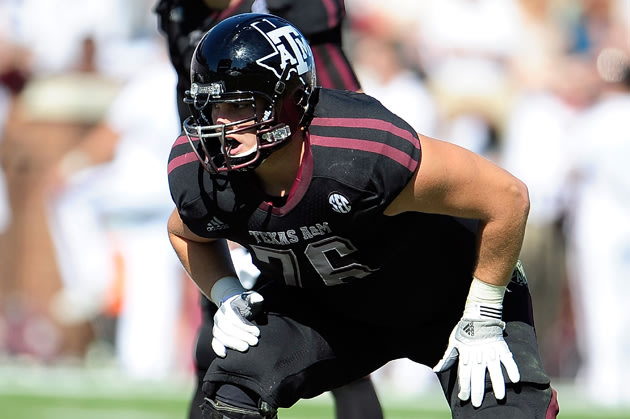
Texas A&M's Luke Joeckel may be the most complete player in his draft class. (Getty Images)
The 2013 NFL draft is far more convoluted than its immediate predecessor. With no obvious transcendent talent to fill the top in the form of an Andrew Luck or Robert Griffin III, you could easily argue five or six different players for the top spot without sounding too crazy. One thing we do know: the downgrade at quarterback is serious, as evidenced by the presence of just one signal-caller in our first Big Board. The line is where NFL teams will find value in this upcoming draft, and that's true on both sides of the ball.
Right now, the Big Board is based more on pure positional talent than team need, and where I think players will actually go. If this was a mock draft, you could see two or three quarterbacks in spots that are one or two rounds above where I think they actually are in the process, but that speaks to the complications of the position in this year's draft. There isn't an overall sure-fire winner this time around, and the 2012 class may be the ultimate outlier, but teams will always reach for arms. That's just the way it is.
So, here's our pre-combine 16 best; you can find 17-32 right here.
1. Luke Joeckel, OT, Texas A&M: The most technically sound lineman of any position in this draft class. Great edge protector, but plays with a right-tackle power. Will only get better with NFL reps.
2. Star Lotuleiei, DT, Utah: If you took game tape of Warren Sapp circa 1999 and sped it up about 20 percent, you'd have what Lotuleiei looks like at his best. A relentless force as an inside penetrator against the run and pass.
3. Chance Warmack, OG, Alabama: Classic straight-up mauler with impressive kick speed and lateral agility. The best in this class at sealing the inside edge. When he gets his hands on a defensive tackle or end, that guy is done. Can handle edge speed impressively well for his size and strength.
4. Eric Fisher, OT, Central Michigan: Plays the run well and can stand up to the bull rush, but pass protection is his specialty. Brings the young Joe Thomas and current Matt Kalil to mind with his kick-slide. Technical marvel with great leverage awareness.
5. Dee Milliner, CB, Alabama: An ideal pattern-read defender with outstanding spatial awareness and trail speed. Not afraid to get his nose busted. He blitzes and sheds blocks well; looks for a fight in a good way.
6. Damontre Moore, DE, Texas A&M: Moore could be the next Aldon Smith, but we're rating him this highly on potential to a degree. Very strong for his size (6-foot-4, 250) and can use impressive speed to get to the quarterback, but needs a bigger palette of hand and foot moves before he'll be a top-level pass-rusher in the NFL. However, the trend toward looping inside rushers (Clay Matthews, Smith, Bruce Irvin) favors Moore more than most.
7. Lane Johnson, OT, Oklahoma: Another Senior Bowl stud. Like Joeckel and Fisher, Johnson hits the NFL with impressive technique. Keeps his head on a swivel and has a really nice kick-slide. Could stand to put on a bit more weight and played primarily out of a two-point stance, but the team that puts in the finishing work could be rewarded with a multi-year Pro-Bowler.
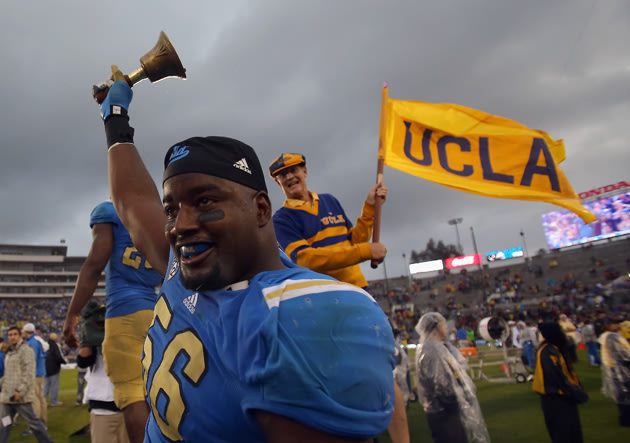
8. Datone Jones, DT, UCLA: Starred at the Senior Bowl. Jones is a great leverage player who knows how to use his hands, and will often be seen knifing through blockers with impressive speed. Has the footwork and upper-body strength to move through and beat slide protection, and does it all from different positions. An underrated asset right now -- the scouting combine might change that. 'Tweener size (6-foot-4, 280) will have some teams wondering where he best fits.
UCLA's Datone Jones: An underrated asset in the right system. (Getty Images)
9. Bjoern Werner, DE, Florida State: Very aware defender, especially when diagnosing run plays in space, and has a real knack for batting passes at the line. Questions abound, however, when watching Werner transfer power to speed from the line. As J.J. Watt did coming out of Wisconsin, Werner will need coaches and coordinators who understand both his skills and liabilities. Total game-changer in the right scheme; could disappear otherwise.
10. Jarvis Jones, DE, Georgia: There are a few obvious Von Miller/Bruce Irvin comps in this draft, but Jones is probably the closest from a pure football speed perspective. Comes off the ball with ridiculous explosiveness and can sometimes get past blockers before they get a chance to set their feet. Will, however, need more overall moves to accentuate a smaller frame that may not stand much additional weight.
11. Barkevious Mingo, DE, LSU: A scud missile without a GPS at times. Mingo often played wide end, which can be a feast-or-famine position. Tremendous speed in space and off the snap, but can easily be blocked out at the line and may have to switch from end to outside linebacker at the next level. Another pass-rusher who would benefit from looping and stunting inside through free gaps.
12. Kenny Vaccaro, FS, Texas: More and more in the NFL, pass defenders must be able to take on many roles. The best safeties are required to play front-half and back-half coverage, and star in the slot in nickel and dime situations. While Vaccaro doesn't have center-field speed, he can play back in a pinch, and he's a very aware defender in the box and in the slot.
13. Geno Smith, QB, West Virginia: The best quarterback in this draft class, and the only one in the first round of the first big board. Inconsistent at times, but his combination of mobility and accuracy has to intrigue quarterback-starved pro teams. Concerns about his having played in a primary shotgun offense are oversold; more than one NFL team takes more than 70 percent of all snaps from the 'gun these days.
14. Keenan Allen, WR, Cal: Allen is an ideal receiver for any team looking to put its pass-catchers in multiple roles, as more NFL teams are doing these days -- watch how often guys like Calvin Johnson are in the slot now. Burns up turf on quick slants and screens; lateral agility in space makes him a nightmare for safeties and slot corners; comes to the NFL with a full array of skills.
15: Alex Okafor, DE, Texas: Had a dominant Senior Bowl week, which erased some concerns I had about his edge speed. Okafor played a lot with his hands off the ground at Texas, and I think he's better suited to be a traditional edge defender who can occasionally shift inside on nickel downs. Great upper-body strength and hand moves; must use leverage to mask lack of pure burst.
16. Cordarrelle Patterson, WR, Tennessee: Patterson is known for his straight-line speed, but don't ignore his ability to make gains in tight spaces on underneath routes -- and his ability to adjust to some fairly "interesting" passes from Tyler Bray. Still finding his feet at the FBS level, but could become a truly dynamic every-level NFL receiver in the right system.

Gareth Roberts
East Valley Consulting